⚙️ BLUF — Bottom Line Up Front
Most homeowners replace kitchen faucets every 3–5 years because big-box fixtures are built to a price point, not a performance standard. The Easy Plumbing luxury faucet is engineered to a different specification entirely — solid brass chassis, ceramic disc valve rated for millions of cycles, and a PVD finish that's molecularly bonded rather than spray-coated. This is the fixture you install once.
01. Why Your Kitchen Faucet Is the Most Critical Interface in Your Home
Consider the actual duty cycle of a kitchen faucet. In an active household, it's cycled on and off 30–50 times per day — more than any other piece of hardware in the home's fluid grid. Over 10 years, that's roughly 100,000 to 180,000 operation cycles before the hardware has earned the right to show wear.
Most residential faucets aren't engineered for that duty cycle. The standard big-box fixture uses zinc-alloy bodies that mineralize and corrode from the inside out, ceramic or rubber seat valves that degrade with thermal cycling, and surface-applied chrome finishes that pit and tarnish within 3–5 years of normal use. The result is a predictable failure sequence: first the finish degrades, then the valve develops drip, then the body starts showing mineral scale penetration. Replacement follows.
From an infrastructure standpoint, this is a solved problem — the components that prevent this failure sequence have existed in commercial and professional-grade plumbing for decades. The question is whether a residential fixture is built to that specification or built to a retail price point.
Easy Plumbing builds to the specification. Here's what that means in practice.
Easy Plumbing Luxury Kitchen Faucet
Lead-Free Solid Brass · Diamond-Seal Ceramic Disc Valve · PVD Finish · 1.8 GPM Optimized Flow · Pro-Style Spring Coil Design
Check Current Availability & Pricing → Opens Easy Plumbing's official site · Affiliate link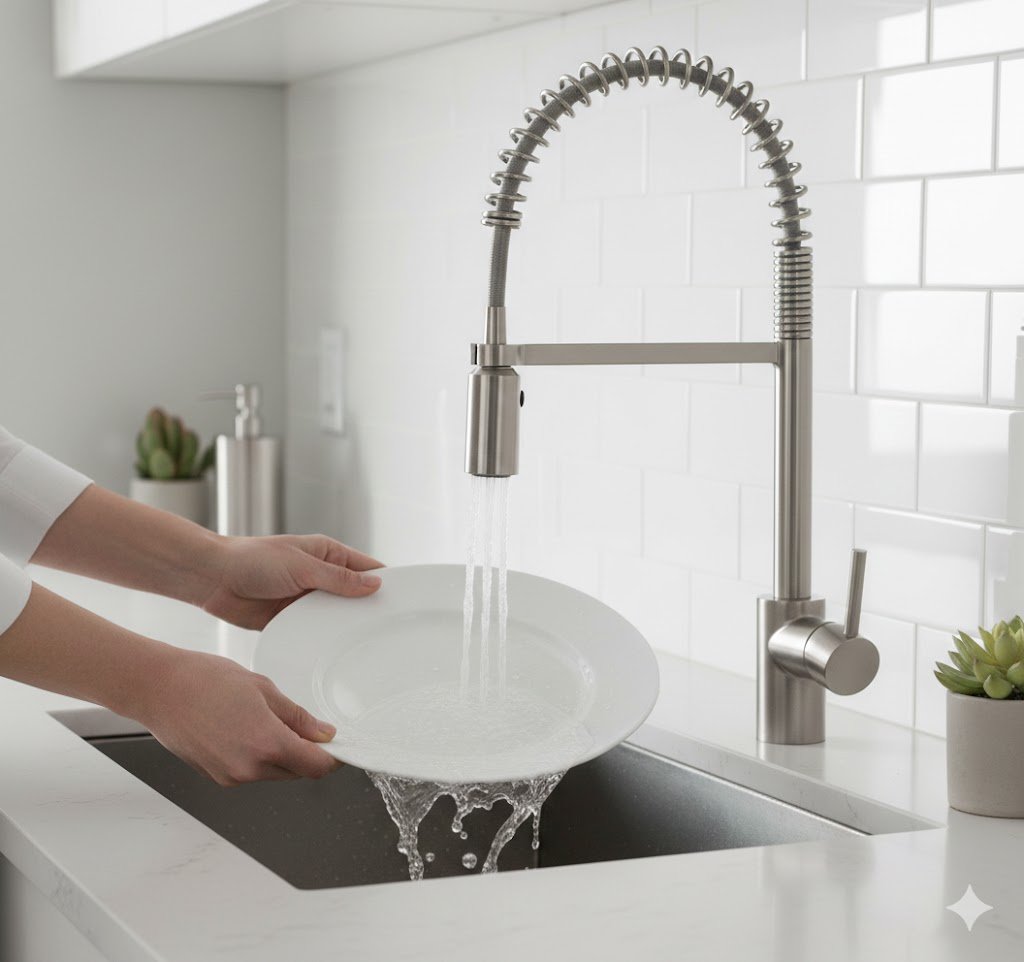
02. The Hardware Standard: Technical Specifications
The Easy Plumbing luxury faucet is built around four components that separate professional-grade fixtures from consumer-grade alternatives. Each one addresses a specific failure mode in standard residential hardware.
Technical Spec Sheet: Easy Plumbing Luxury Kitchen Faucet
| Attribute | Specification |
|---|---|
| Valve Technology | Diamond-Seal Ceramic Disc |
| Chassis Material | Lead-Free Solid Brass |
| Flow Rate | 1.8 GPM (Optimized) |
| Mounting Configuration | Single-Hole Integrated Deck Mount |
| Finish Technology | PVD (Physical Vapor Deposition) |
| Spray Modes | Dual-Function with Magnetic Dock |
| Compliance | NSF/ANSI 61 · ADA Compatible |
Solid Brass Chassis — The structural foundation of the fixture. Brass resists mineralization and corrosion at a fundamentally different level than zinc-alloy alternatives. In high-mineral or chlorinated municipal water supplies, zinc-alloy bodies begin showing internal corrosion within 2–3 years. Brass bodies maintain structural integrity across a 20+ year service window under normal residential conditions. This isn't a cosmetic difference — it's the component that determines whether the fixture is still serviceable in 2035.
Diamond-Seal Ceramic Disc Valve — The valve is the most mechanically stressed component in any faucet. Diamond-Seal ceramic disc technology uses a molecularly hard ceramic surface that maintains a zero-leak seal through thermal cycling, mineral exposure, and millions of operation cycles. The industry standard for commercial and professional fixtures for good reason: it doesn't degrade the way rubber seat valves do. This is the component that eliminates the drip.
PVD Finish — Physical Vapor Deposition isn't a coating applied to the surface — it's a molecular bonding process that integrates the finish into the outer layer of the brass chassis. The result is a finish that's harder than the underlying metal, essentially impervious to scratching from normal kitchen use, and resistant to the tarnishing and pitting that degrades standard chrome or brushed nickel finishes within a few years. The finish you install is the finish you have a decade later.
1.8 GPM Flow Rate — This is the optimized specification. Standard residential faucets run 2.2 GPM; older fixtures can exceed that. The 1.8 GPM rating isn't a restriction that compromises function — it's a precisely engineered flow rate that maintains full functional pressure and spray performance while reducing water consumption by roughly 18% relative to standard fixtures. For households paying attention to utility costs or operating under low-flow mandates, this matters. For everyone else, it's a conservation benefit with no functional tradeoff.
03. The Interface Logic: Precision Control Architecture
The design framework that separates this fixture from standard residential hardware is the treatment of the faucet as a precision control interface rather than a utility fitting.
Dual-Function Spray Head with Magnetic Docking — The pull-down spray head operates in two modes: stream for filling and rinsing, spray for surface cleaning and produce washing. The magnetic docking system returns the head to its seated position with positive engagement — not a friction fit or gravity drop, but an active magnetic connection that holds the head locked in the ready position. In practice, this eliminates the drooping spray head problem that develops in lower-quality pull-down fixtures within 12–18 months of use.
Pro-Style Spring Coil Design — The coiled spring that supports the pull-down hose serves a structural function beyond aesthetics: it maintains consistent hose tension across the full range of extension, preventing the hose from developing a set or kink over time. Commercial kitchen fixtures have used this design for decades for exactly this reason. It's engineering borrowed from professional environments where the fixture has to perform reliably under continuous heavy use.
04. TCO Analysis: The Real Cost of Getting This Wrong
Big-Box Fixture TCO (10-Year Horizon): Initial Purchase ($80–150) + Replacement at Year 3–5 ($80–150 + 2–3 hours labor) + Second Replacement at Year 7–9 (repeat) = $400–600+ over 10 years, plus the friction of three installation events.
Easy Plumbing Luxury Fixture TCO (10-Year Horizon): Initial Purchase Price. One installation event. Fixture still performing within specification at year 10.
The Mean Time Between Failure (MTBF) differential between zinc-alloy consumer fixtures and solid brass professional fixtures isn't marginal — it's 3–5x. A fixture engineered to last 20 years at a price point 2–3x higher than a fixture engineered to last 5 years is the superior economic decision by year six at the latest.
The less quantifiable cost is the installation event itself. Every faucet replacement requires shutting off the water supply, disconnecting supply lines, working in a confined under-sink space, and re-testing for leaks. Once is unavoidable. Twice in a decade is a choice.
One Installation. Decade-Long Performance.
The ceramic disc valve and solid brass chassis specification eliminates the 3–5 year replacement cycle. Check current finish options and configurations from Easy Plumbing.
View Specs & Current Pricing at Easy Plumbing → Opens Easy Plumbing's official site · Affiliate link05. Honest Assessment: Strengths and Considerations
Where this fixture delivers without qualification:
The PVD finish is the most immediately visible differentiator from standard residential hardware. The brushed nickel finish in the Gemini-generated image above illustrates the depth and consistency that PVD achieves — it's a fundamentally different appearance from spray-applied chrome or electroplated finishes. In a kitchen with white subway tile and quartz countertops, this fixture is a visual upgrade on its own terms, not just a functional one.
Single-hole mounting simplifies installation relative to 3-hole configurations and works with virtually every modern undermount and drop-in sink configuration. The clean deck profile it creates is consistent with contemporary kitchen design direction.
The pro-style spring coil design reads as commercial-grade in a residential kitchen — if that aesthetic is part of your kitchen direction, this fixture delivers it authentically rather than as a consumer approximation.
Where to think carefully before purchasing:
Single-hole mounting means this fixture requires a single pre-drilled hole in the sink deck or countertop. If you're replacing a 3-hole faucet, you'll need to address the unused holes — deck plates are available for this, but it's a consideration worth noting before purchasing.
The pro-style spring coil profile has significant vertical presence. In kitchens with upper cabinets positioned lower than standard, verify clearance before purchasing. The spring coil and pull-down range need unobstructed vertical space to function correctly.
At the premium price tier, this fixture competes with Kohler, Moen's high-end lines, and Delta's professional series. Easy Plumbing's specification is competitive at this level — the ceramic disc valve and PVD finish are industry standards at this price point, not differentiators unique to this brand.
06. SME Verdict
For kitchen renovations or fixture replacements where the goal is to install once and not revisit the decision for 15–20 years, the Easy Plumbing luxury faucet meets the specification. The solid brass chassis, ceramic disc valve, and PVD finish address the three primary failure modes of standard residential fixtures. The 1.8 GPM flow rate delivers conservation benefit without functional compromise.
If you're replacing a fixture for the second time in a decade, this is the correct answer to that cycle.
Ready to Upgrade Your Kitchen's Water Interface?
Check current finish options, configuration details, and technical documentation directly from Easy Plumbing. Solid brass. Ceramic disc valve. PVD finish. Built to outlast the kitchen it's installed in.
View Easy Plumbing Luxury Faucet — Current Availability → Opens Easy Plumbing's official site · Affiliate link · Opens in new tab