⚙️ BLUF — Bottom Line Up Front
Most gravity filter pitchers are solving the wrong problem — they focus on flow rate convenience while underdelivering on filtration depth and ignoring the maintenance monitoring problem entirely. The Waterdrop Chubby addresses all three: 7-stage NSF-certified filtration, a natural wood ergonomic handle, and an integrated LED that tells you exactly when the filter has reached its operational limit. No guesswork, no degraded performance drift.
01. The Gravity Filter Problem Nobody Talks About
Gravity-fed pitcher filters have a fundamental operational vulnerability that most manufacturers quietly ignore: the filter replacement problem. Standard pitcher filters come with a vague "replace every 2 months" guidance printed on the box — a calendar-based instruction that has nothing to do with actual filter condition. A household that runs 8 cups a day through the filter reaches its 200-gallon capacity at a different point than a household running 20 cups a day. Calendar guidance applied to usage-variable systems produces predictable results: filters running past their rated capacity, contamination rejection rates dropping, and the user pouring "filtered" water that's no longer being filtered to specification.
This is the maintenance drift problem. It's not unique to water filters — it's the same failure mode that shows up when any consumable-dependent system lacks actual usage monitoring. The solution in professional infrastructure environments is instrumented monitoring: the system reports its own status rather than relying on the operator's calendar discipline.
The Waterdrop Chubby Pitcher (WD-PT-04W) addresses this with an integrated gravity induction LED that monitors actual filter usage rather than elapsed time. When the filter reaches its operational limit, the system signals it. No calendar math, no guesswork, no degraded-performance drift.
That's the engineering decision that separates this pitcher from the standard gravity filter category.
Waterdrop Chubby Pitcher — WD-PT-04W
7-Stage Filtration · NSF 42 / NSF 372 Certified · Integrated LED Filter Monitor · 10-Cup Capacity · BPA-Free + Natural Wood Handle
Check Current Availability & Pricing → Opens Waterdrop's official site · Affiliate link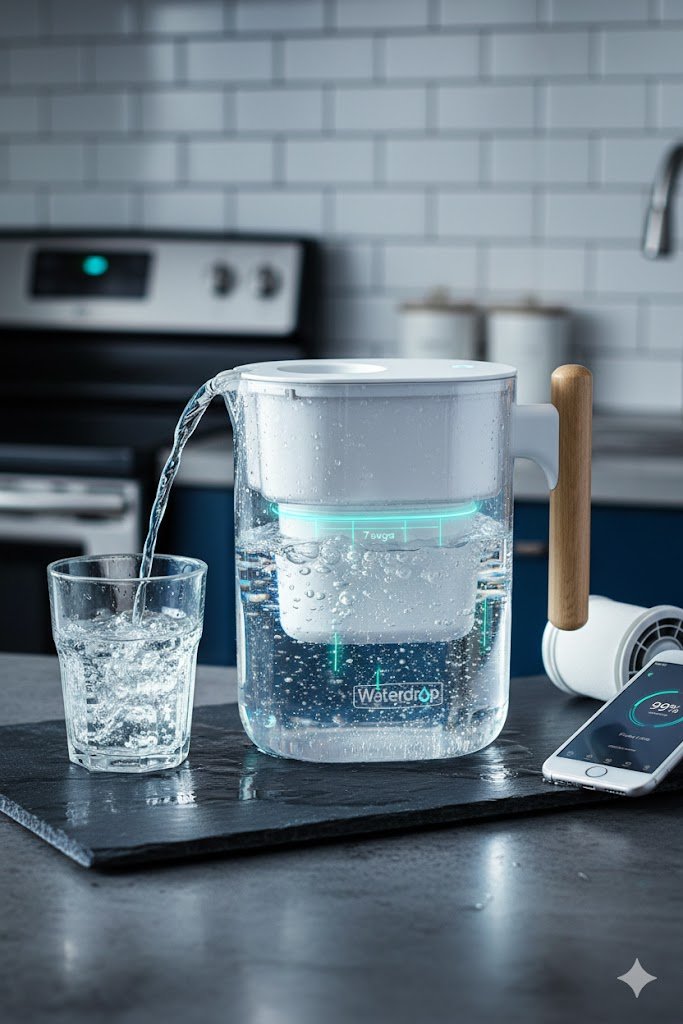
02. Technical Specifications & Certifications
Technical Spec Sheet: Waterdrop Chubby Pitcher
| Attribute | Specification |
|---|---|
| Model | WD-PT-04W (Chubby Series) |
| Capacity | 10-Cup / 80 oz |
| Filtration Lifecycle | 200 Gallons (~3 months average use) |
| Certification | NSF/ANSI 42 · NSF/ANSI 372 (Lead-Free) |
| Filtration Stages | 7-Stage Stack |
| Filter Media | Japanese-Sourced Activated Carbon Fiber (ACF) |
| Body Material | High-Grade BPA-Free Plastic |
| Handle | Natural Wood Ergonomic Grip |
| Filter Monitor | Integrated Gravity Induction LED |
The NSF certifications deserve specific attention. NSF/ANSI 42 is the standard for aesthetic effects — taste, odor, chlorine reduction — and it requires third-party laboratory verification, not manufacturer self-reporting. NSF/ANSI 372 certifies lead-free construction throughout the product, meaning no lead leaching from the pitcher body or components into the filtered water. These are minimum acceptable standards for any filtration product entering a home with children or pregnant household members. The Chubby carries both.
The Japanese-sourced Activated Carbon Fiber (ACF) filter media is a meaningful specification differentiator. ACF has a higher surface area per gram than granular activated carbon (GAC) — the standard media in most gravity pitcher filters — which translates to more adsorption sites per filter and higher contaminant capture efficiency at equivalent flow rates. It's not a marketing distinction. It's a materials science difference with measurable performance implications.
03. The 7-Stage Filtration Architecture
Standard gravity pitcher filters operate on 1–3 stages, primarily targeting chlorine taste and odor. The Chubby's 7-stage stack extends the filtration envelope considerably:
Pre-Filtration Layer — Captures sediment, rust, and large particulates before they reach the primary filter media. Extends filter lifecycle by preventing premature clogging of downstream stages.
Activated Carbon Fiber Stages (Multiple) — The ACF core provides high-surface-area adsorption for chlorine, chloramines, THMs, VOCs, and organic compounds that affect taste and odor. Multiple ACF stages provide extended contact time versus single-stage configurations.
Ion Exchange Layer — Addresses heavy metals including lead, mercury, and cadmium. This is the stage that standard pitcher filters omit and the stage that matters most in homes with copper plumbing, older galvanized supply lines, or municipal systems with documented heavy metal variance.
Post-Polish Stage — Final clarity pass before the water exits the filter, removing any residual particulates from upstream stages.
The 200-gallon filter lifecycle at this filtration depth is the correct tradeoff. Deeper filtration with higher-quality media costs more per filter, lasts longer per filter, and delivers better water quality throughout the lifecycle versus cheap filters with high replacement frequency.
04. The ROI Case: Bottled Water vs. Filtered Infrastructure
This is where the Chubby's value proposition becomes arithmetically obvious.
One filter cycle covers 200 gallons. A standard 16-oz plastic bottle is 0.125 gallons. One Waterdrop Chubby filter therefore replaces approximately 1,600 single-use plastic bottles per replacement cycle.
Bottled Water Annual Cost (average household): $0.50–$1.50 per bottle × 4–6 bottles per day × 365 days = $730–$3,285 per year
Waterdrop Chubby Annual Cost: Pitcher (one-time) + 4 replacement filters per year = a fraction of the bottled water baseline, with zero plastic waste accumulation.
The plastic waste reduction is the secondary benefit with its own material value: 1,600 bottles per filter cycle, 4 cycles per year, over a 5-year product lifespan represents approximately 32,000 plastic bottles that don't enter the waste stream. For households tracking environmental overhead alongside financial overhead, this is a meaningful delta.
1,600 Bottles Per Filter. Do the Math.
The NSF-certified 7-stage filter and integrated LED monitor make the Chubby the correct gravity pitcher specification. Check current configurations and bundle pricing from Waterdrop.
View Chubby Pitcher Specs & Current Pricing → Opens Waterdrop's official site · Affiliate link05. Honest Assessment: Strengths and Considerations
Where the Chubby delivers without qualification:
The integrated LED monitor is the feature that most gravity pitcher users will notice immediately after switching from a standard pitcher. The maintenance drift problem — running a filter past its rated capacity without knowing it — is eliminated. The LED reports actual filter status based on usage, not calendar estimates. This alone changes the ownership experience.
The natural wood handle is an ergonomic and aesthetic decision that works. A 10-cup pitcher at capacity weighs approximately 5.5 lbs — handle ergonomics matter at that weight. The wood grip provides purchase that smooth plastic handles don't, and the material contrast with the clear BPA-free body gives the Chubby a design character that most utility pitchers lack entirely.
The 10-cup capacity is right-sized for countertop kitchen deployment. Large enough to cover a household's immediate filtered water needs without multiple fills per day, compact enough to fit on a standard refrigerator shelf or counter without displacement issues.
Where to think carefully before purchasing:
This is a gravity filter. Filtration happens by gravity flow through the filter cartridge — there's a fill-and-wait sequence that electric pump systems eliminate. For users accustomed to the on-demand flow of the ED01W or an under-sink RO system, the gravity filtration pace is a different experience. It's not slow by gravity pitcher standards — the 7-stage ACF stack flows well — but it's not instant.
The 200-gallon / ~3-month filter lifecycle assumes average household use. Heavy users will reach replacement sooner. The LED monitor removes the guesswork here, but budget for 4–5 filter replacements per year in a high-consumption household rather than the standard 4.
The Chubby addresses chlorine, VOCs, heavy metals, and organic compounds effectively. It does not filter to RO membrane resolution. For households with very high TDS readings, known PFAS contamination, or documented microbiological concerns, an under-sink RO system is the correct primary specification — the Chubby is a complementary node, not a replacement for that level of treatment.
06. SME Verdict
For kitchen countertop or refrigerator deployment where the goal is reliable gravity filtration with actual maintenance monitoring — not calendar-based guesswork — the Waterdrop Chubby is the correct specification in its category. The NSF dual-certification, 7-stage ACF filtration depth, and integrated LED monitor address the three primary shortfalls of standard gravity pitcher alternatives: certification rigor, filtration depth, and maintenance visibility.
At the price point, the ROI against bottled water consumption is straightforward. The filter lifecycle and LED monitoring mean the system operates within specification for its full rated capacity rather than degrading silently past it.
Ready to Deploy the Chubby?
Check current inventory, filter bundle options, and full technical documentation directly from Waterdrop. NSF-certified, LED-monitored, and built to outlast the plastic bottle habit.
View Waterdrop Chubby Pitcher — Current Availability → Opens Waterdrop's official site · Affiliate link · Opens in new tab