⚙️ BLUF — Bottom Line Up Front
Under-sink RO systems solve the kitchen filtration problem completely — but they don't solve the home office, the upstairs bedroom, or the guest suite. The Waterdrop ED01W is the correct secondary node: 5-stage filtration, 30-day battery life, USB-C charging, and zero plumbing involvement. It extends filtered water access to wherever you actually work and live.
01. The Infrastructure Gap Traditional Systems Don't Solve
Whole-home and under-sink RO systems are purpose-built for kitchen deployment. That's the right solution for the kitchen. But consider the actual geography of daily water consumption in a modern home: the home office where you're working through the afternoon, the upstairs suite where you start the morning, the guest room that sees irregular use. None of these locations have plumbing access. All of them represent friction points where the alternative is a bottled water run or a trip downstairs.
From an infrastructure standpoint, this is a distribution problem. The primary filtration node — the under-sink RO system — solves centralized access. It does nothing for distributed access.
The traditional answer has been gravity-fed pitcher filters: a Brita or PUR on the counter, refilled manually, chilled in the refrigerator. The engineering tradeoffs of that approach are straightforward: low throughput, gravity-dependent flow rate, no active pump, filter replacement driven by guesswork rather than monitoring, and a design that hasn't changed meaningfully in 30 years.
The Waterdrop ED01W is a different category of answer. It's an active filtration system with an internal electric pump, a 5-stage filter stack, and a 30-day battery — designed specifically for locations where plumbing access doesn't exist and gravity-fed performance isn't acceptable.
Waterdrop ED01W — 1-Year Combo Bundle
5-Stage Filtration · 30-Day Battery · USB-C Charging · 15-Cup Reservoir · No Plumbing Required
Check Current Availability & Pricing → Opens Waterdrop's official site · Affiliate link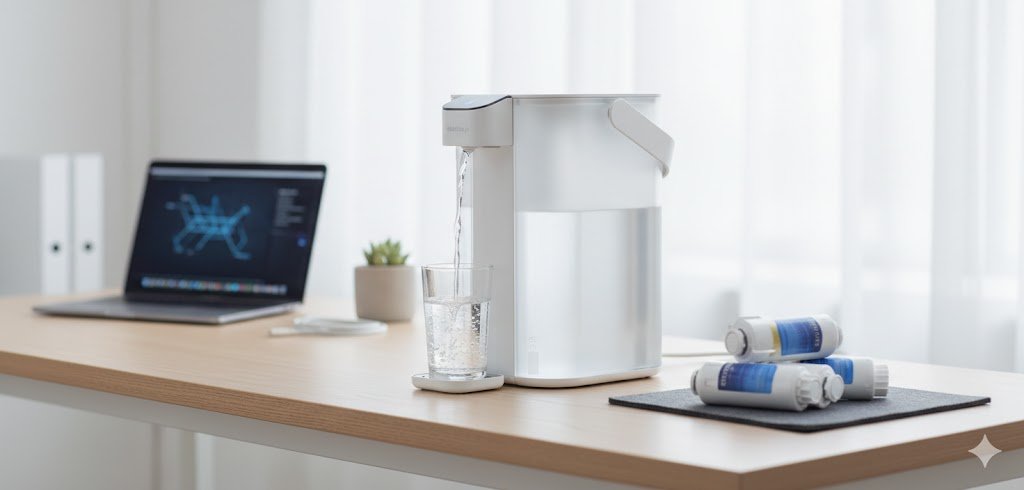
02. System Overview & Technical Specifications
The ED01W operates on an internal high-torque electric pump rather than gravity, which has downstream effects on every practical performance metric: flow rate is consistent regardless of reservoir fill level, dispensing is immediate on demand, and the system doesn't require elevation or refrigerator placement to function.
Technical Spec Sheet: Waterdrop ED01W
| Attribute | Specification |
|---|---|
| Model | WD-ED01W (White Edition) |
| Pump Architecture | High-Torque Internal Electric |
| Battery Capacity | 800mAh · 30-Day Operational Window |
| Charging Interface | USB-C (Universal Standard) |
| Filtration Stack | 5-Stage Performance Configuration |
| Reservoir Capacity | 15-Cup / 120 oz |
| Dispense Interface | One-Touch Integrated Control |
| Footprint | Slim-Profile Countertop Design |
The 30-day battery rating warrants context. 800mAh against a 30-day operational window reflects the efficiency of the pump architecture — the system draws power only during active dispensing, not continuously. For a home office deployment where the system is used 5–10 times daily, 30 days per charge is a realistic operational figure, not a marketing ceiling.
USB-C charging is the correct specification decision for 2025. It means the ED01W charges from the same cable infrastructure as every other device in a modern home office — no proprietary adaptor to track, no legacy connector to manage.
03. The 5-Stage Filtration Stack
The performance gap between a gravity pitcher and the ED01W isn't just mechanical — it's filtration depth. Standard pitcher filters use a single activated carbon stage, which addresses chlorine taste and some VOCs. That's the complete filtration story for most gravity-fed products.
The ED01W's 5-stage stack operates at a different level:
Stage 1 — Sediment Pre-Filter: Captures particulates, rust, and suspended solids before they reach downstream stages. Protects filter longevity by removing the material that degrades carbon and membrane filters prematurely.
Stage 2 & 3 — Activated Carbon Block: Dual-stage carbon treatment for comprehensive removal of chlorine, chloramines, THMs (trihalomethanes), and VOCs. Two stages provide redundancy and extended contact time compared to single-stage pitcher filters.
Stage 4 — Ion Exchange Resin: Addresses heavy metals — lead, mercury, cadmium — that activated carbon alone doesn't effectively capture. This is the stage that matters most in homes with older plumbing or municipal systems with known heavy metal variance.
Stage 5 — Post-Polish Filter: Final-stage polishing for taste, odor, and any residual particulates from upstream stages. What enters the glass has passed through the complete stack.
The 1-Year Combo Bundle pairs the ED01W with a full year of replacement filters, which mirrors the lifecycle management logic of the G3P800 2-Year Bundle: plan the consumable cost at procurement, maintain the system within its performance window, avoid the degraded-filter scenario.
04. Practical Deployment: Where This Actually Belongs
The ED01W's design parameters make it purpose-built for specific deployment scenarios that under-sink and whole-home systems don't address.
Home Office — The image above is the canonical deployment. Filtered water on the desk, recharged weekly from the same USB-C hub as the laptop and peripherals, refilled from the kitchen tap. No trips downstairs mid-afternoon, no bottled water inventory to manage.
Bedroom / Nightstand — A 15-cup reservoir covers overnight and morning consumption for a household member who prefers filtered water available on demand without kitchen access.
Guest Suite — Periodic-use deployment where installing permanent plumbing is disproportionate. The ED01W provides guest-ready filtered water without infrastructure investment.
Small Apartment / Studio — For living situations where an under-sink RO installation isn't practical (renting, limited cabinet space, landlord restrictions), the ED01W provides 5-stage filtration performance from a countertop footprint.
What it isn't: a replacement for an under-sink RO system in a primary kitchen application. The 120 oz reservoir and countertop footprint are appropriate for secondary deployment. If the kitchen is the primary use case and plumbing access exists, the G3P800 is the correct specification.
The 1-Year Combo Bundle: Lifecycle Management Built In
Includes the ED01W system plus a full year of replacement filters. Same logic as the G3P800 bundle — plan the consumable cost at procurement, not as a recurring surprise.
View the 1-Year Bundle — Specs & Current Pricing → Opens Waterdrop's official site · Affiliate link05. Honest Assessment: Strengths and Considerations
Where the ED01W delivers without qualification:
The electric pump is the definitive advantage over gravity pitchers. Consistent flow rate regardless of reservoir level, immediate dispense on demand, no tilting or waiting. Anyone who's used a gravity pitcher in the last 20% of its reservoir knows the frustration — it's not a small thing in daily use.
USB-C charging genuinely simplifies the ownership experience. No proprietary charger to lose, no searching for the right cable. It charges from any USB-C power delivery source in the home.
The slim countertop profile is legitimately compact. It occupies roughly the footprint of a standard water bottle on its side — appropriate for desk deployment without consuming meaningful workspace.
The 5-stage filtration depth is the strongest argument against gravity pitcher alternatives at comparable price points. The ion exchange stage for heavy metals is the differentiator that single-stage carbon filters simply don't offer.
Where to think carefully before purchasing:
The 120 oz reservoir requires refilling from a tap. For a home office deployment, this means a periodic trip to the kitchen — roughly once per day for a single user with moderate consumption. This is less friction than a bottled water run, but it's not zero friction.
The electric pump requires battery management. 30 days per charge is generous, but it's a variable that gravity pitchers don't introduce. A dead battery means gravity-feed only until recharged — worth knowing before deployment in a critical-access scenario.
This is a filtration system, not an RO system. The 5-stage stack is excellent for its category and significantly outperforms single-stage pitcher filters. It does not filter to the 0.0001 micron resolution of an RO membrane. For users in areas with serious water quality concerns — high TDS, pharmaceutical residuals, PFAS — the under-sink RO specification is the appropriate primary system.
06. SME Verdict
For distributed water access — home offices, bedrooms, guest suites, or any location where plumbing isn't available and gravity-pitcher performance isn't acceptable — the Waterdrop ED01W is the correct specification. It solves the coverage gap that under-sink RO systems leave open, with filtration depth that single-stage pitcher filters can't match.
The 1-Year Combo Bundle is the right procurement configuration. Plan the filter replacement cost at purchase, maintain the system within its performance window, and the ED01W becomes a zero-friction part of the home's water infrastructure.
Ready to Close the Coverage Gap?
The ED01W 1-Year Combo Bundle includes the system and a full year of filters. Check current availability and technical documentation directly from Waterdrop.
View Waterdrop ED01W 1-Year Bundle — Current Availability → Opens Waterdrop's official site · Affiliate link · Opens in new tab