⚙️ BLUF — Bottom Line Up Front
The Waterdrop G3P800 is the first residential RO system I've evaluated that's built to infrastructure standards rather than consumer-appliance standards. The 800 GPD throughput, tankless architecture, and integrated UV sterilization solve three real problems simultaneously. The 2-Year Bundle is the correct procurement decision — here's why.
01. Why Most RO Systems Fail the Infrastructure Test
Spend any time evaluating residential water filtration and a pattern emerges quickly: the majority of systems on the market are engineered around one metric — price at point of sale. Filter replacement costs, throughput degradation, and secondary contamination risk are treated as afterthoughts.
From an infrastructure standpoint, that's the wrong framework entirely.
When I evaluate a system, I'm asking the same questions I'd ask about any mission-critical deployment: What's the throughput under load? Where are the single points of failure? What does the maintenance lifecycle actually cost? What's the failure mode when a component degrades?
Most RO systems fail on question three and four before we even get to the others.
The legacy tank-based architecture — where filtered water sits in a pressurized bladder tank waiting to be used — introduces what I'd call latency contamination risk: standing water, bladder degradation over time, and a maintenance overhead that most homeowners simply don't execute. The result is a system that degrades quietly, and the homeowner has no visibility into the degradation until there's an obvious problem.
The Waterdrop G3P800 was the first residential system I evaluated that addressed these failure modes by design rather than leaving them to the user.
Waterdrop G3P800 — 2-Year Bundle
800 GPD · 9-Stage Filtration · Tankless Architecture · UV Sterilization + 2-Year Filter Supply
Check Current Availability & Pricing → Opens Waterdrop's official site · Affiliate link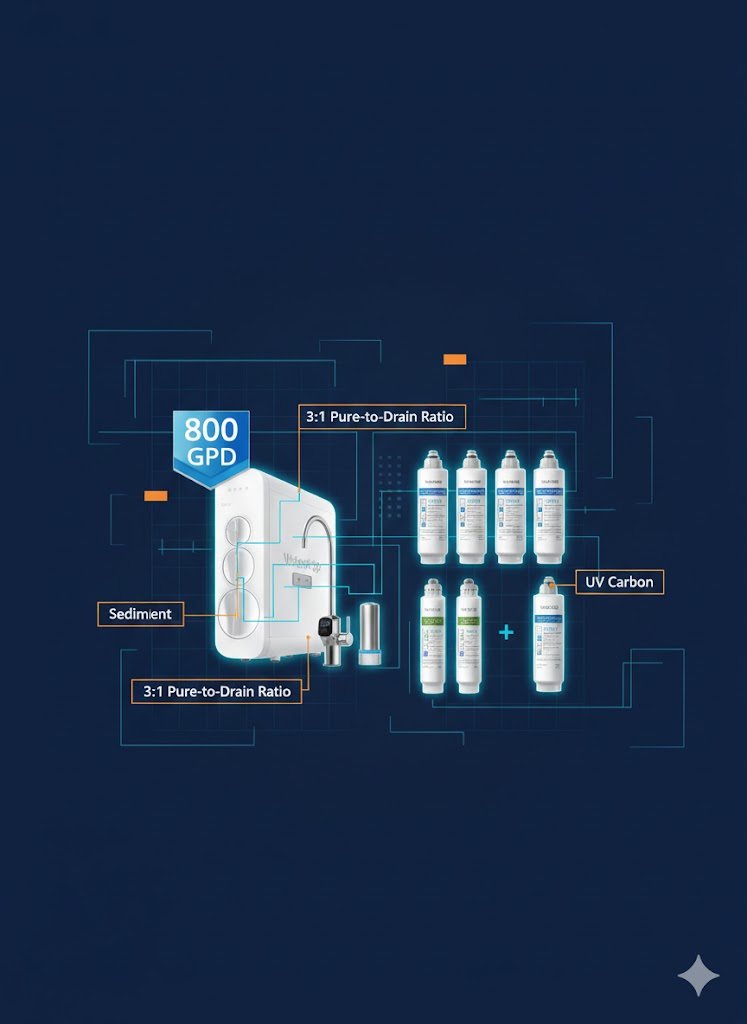
02. System Overview & Deployment Logic
The Waterdrop G3P800 (WD-G3P800-W) represents a meaningful architectural departure from legacy residential RO systems. For anyone who thinks in infrastructure terms, this system is best understood as a High-Throughput Gateway for home water utility.
The core design decision — eliminating the pressurized storage tank entirely — has downstream effects on every other system metric.
Key Technical Specifications
| Attribute | Specification |
|---|---|
| Model | WD-G3P800-W (G3P800) |
| Throughput | 800 GPD (Gallons Per Day) |
| Filtration Layers | 9-Stage Integrated Stack |
| Pure-to-Drain Ratio | 3:1 (High Efficiency) |
| Footprint | 18.06" × 5.65" × 17.75" |
| Input Tolerance | 41–100°F Feed Water |
| Filtration Resolution | 0.0001 Microns (RO Membrane) |
| UV Kill Rate | 99.9% (Viruses & Bacteria) |
| Under-Sink Space Saved | ~70% vs. Tank-Based Systems |
The 800 GPD figure deserves context. Most households run 2–5 GPD of actual filtered water consumption. 800 GPD means this system will never be a bottleneck — throughput is effectively on-demand, not queued through a tank. For households with high water usage patterns (cooking, dedicated fridge filters, ice makers), this headroom matters.
03. The Hardware Stack: Filtration Architecture
The G3P800 operates on a 9-stage logic stack designed to maximize membrane lifespan while delivering consistent output purity. The sequencing matters — each stage conditions the water for the next.
Stage breakdown, in operational order:
Pre-Sediment Layer — Captures large-scale particulates: scale, rust, and suspended solids. This is the first line of defense and the primary mechanism for protecting the RO membrane from premature degradation.
Carbon Block — Neutralizes chlorine, chloramines, and VOCs (Volatile Organic Compounds). Municipal water treatment relies heavily on chlorine; this stage removes it before it reaches the membrane, which chlorine will permanently damage if exposed.
Advanced RO Membrane — The core processing unit. Filters down to 0.0001 microns, which is the threshold for removing dissolved heavy metals, pharmaceutical residuals, PFAS compounds, and most waterborne pathogens. This is where the actual "purification" happens.
UV Sterilization — An integrated LED UV stage that activates automatically on flow detection. Provides a 99.9% inactivation rate for viruses and bacteria without introducing any chemical residuals. This is the stage that separates the G3P800 from systems that stop at RO filtration alone.
The remaining stages address remineralization and final polishing — filtered water at 0.0001 microns is essentially mineral-free, and the post-filters restore a balanced mineral profile for taste and health.
04. Lifecycle Management — The 2-Year Bundle Case
This is where the infrastructure framing becomes financially concrete.
Most RO system purchases have a hidden second price: the ongoing filter replacement cost. Manufacturers price the hardware at a margin that assumes recurring filter revenue. When you don't plan the lifecycle upfront, you end up either over-paying for individual filter replacements or — more commonly — running the system past its service window.
Running a degraded RO membrane doesn't mean you get slightly less clean water. It means the system's contamination rejection rate drops while you continue believing the water is being treated.
The G3P800 2-Year Combo Bundle solves this at procurement:
Operational Continuity — The bundle includes a complete 2-year supply of replacement filters at a bundled discount. The system stays within its rated performance window for 24 months without an additional procurement event.
The Management Console — The G3P800's smart faucet integrates a real-time TDS (Total Dissolved Solids) monitor and a filter life indicator directly into the tap hardware. This is the visibility layer most RO systems lack entirely. You're not guessing at filter condition — the system reports it.
For anyone who's managed infrastructure, this is the difference between proactive monitoring and finding out about failure after the fact.
The 2-Year Bundle: Pre-Planned Lifecycle Management
Stop the single-filter replacement cycle. Lock in 24 months of peak performance at bundle pricing. Includes the smart faucet with integrated TDS monitor.
View the 2-Year Bundle Specs & Pricing → Opens Waterdrop's official site · Affiliate link05. Honest Assessment: What It Does Well and Where to Think Twice
What it does exceptionally well:
The tankless architecture genuinely eliminates the tank contamination vector. This isn't marketing language — a pressurized bladder tank is a documented maintenance liability in legacy systems, and removing it from the design simplifies both the system and the risk profile.
The 800 GPD throughput means the system never creates a bottleneck. In practical terms: you turn on the tap and get filtered water at full pressure, not the trickle that tank-based systems often produce when the tank is partially depleted.
The UV stage is the differentiator at this price tier. Most systems in this category stop at RO filtration. Adding a chemical-free UV sterilization stage addresses the viral/bacterial risk that RO filtration alone doesn't fully cover — particularly relevant for well water or areas with aging municipal infrastructure.
Where to think carefully before purchasing:
Installation requires connection to your home's cold water supply line under the sink — this is a manageable DIY project for anyone handy with basic plumbing, but it's not a plug-in setup. Budget 1–2 hours for installation and have a bucket and towels available.
The 3:1 pure-to-drain ratio is marketed as high efficiency, and it is — relative to older RO systems that ran 1:3 or worse. But you will produce drain water as part of the filtration process. For most municipal water users this is a non-issue; for well users paying attention to water table impact, it's worth noting.
Power is required for the UV stage and the smart monitoring. The system draws minimal wattage, but it does need an outlet under the sink.
06. SME Verdict
For households where water quality is a genuine variable — municipal systems with aging infrastructure, well water, or simply a household that uses significant filtered water volume daily — the G3P800 2-Year Bundle is the correct procurement decision.
The 800 GPD throughput eliminates the single biggest complaint about residential RO systems: inadequate flow rate. The tankless design eliminates the maintenance liability of pressurized storage. The integrated UV stage closes the gap that RO filtration alone leaves open. And the 2-Year Bundle resolves the lifecycle management problem before it becomes a recurring headache.
From an infrastructure standpoint, this is a well-architected residential system. It addresses the actual failure modes of legacy designs rather than iterating on the same compromised architecture.
If you're evaluating home water infrastructure seriously, this is where the evaluation stops.
Ready to Deploy the G3P800?
Check current inventory, bundle options, and technical documentation directly from Waterdrop. The 2-Year Bundle is the configuration we recommend — priced for lifecycle value, not just upfront cost.
Check Current Availability: G3P800 2-Year Bundle → Opens Waterdrop's official site · Affiliate link · Opens in new tab